Blog
Can You Spray Pesticides with a Drone in Canada? What BC Growers Need to Know in 2026
If you've been watching the regulatory landscape for agricultural drones in Canada, 2026 has been a year worth waiting for. Health Canada just issued an interim Letter of No Objection that effectively opens the door for spray drones to apply crop protection products across the country - including fungicides, herbicides, and pesticides that carry an existing aerial application label.
For BC growers working steep Okanagan slopes, tight orchard rows, and fields that are routinely too wet or inaccessible for ground equipment, this is a significant shift. Here's what it means, what the rules actually say, and what you need to know before you put a drone in the air.
What Changed - And When
Canada's regulatory journey with spray drones has been a long one. When agricultural spray drones first became practical tools around 2020, Health Canada took a cautious stance: a blanket restriction on pesticide application by drone, with only a handful of specific products approved on a case-by-case basis. None of those were for broad-acre agricultural use.
Meanwhile, the US treated drones as aircraft from the start, allowing operators to apply at aerial rates under the same rules as manned planes. Farmers south of the border spent years accumulating experience that Canadian growers simply weren't permitted to get.
That changed in February 2026, when Health Canada's Pest Management Regulatory Agency (PMRA) published Regulatory Proposal PRO2026-01 - a proposal to allow drones to apply any crop protection product already registered for aerial application. The consultation period ran through spring, and in June 2026, Health Canada issued an interim Letter of No Objection, giving operators immediate flexibility to apply those products while the final policy is finalized.
The bottom line: if a product has an aerial application label, you can now apply it by drone in Canada. The final policy is expected to mirror this interim decision closely.
For BC growers working steep Okanagan slopes, tight orchard rows, and fields that are routinely too wet or inaccessible for ground equipment, this is a significant shift. Here's what it means, what the rules actually say, and what you need to know before you put a drone in the air
What You Can (and Can't) Spray
Under the current framework, the rules are straightforward:
Permitted now:
Any crop protection product with an existing aerial application label - this includes fungicides, herbicides, desiccants, and insecticides registered for aerial use
Liquid nutrients, bio-stimulants, fulvic/humic acids
Granular fertilizer and seed broadcasting (this has always been permitted)
Important conditions:
Application must fully comply with all label directions for aerial application - no changes to spray volume, application rate, droplet size, or buffer zones
The person mixing and loading pesticides must be different from the drone pilot
Mixers, loaders, pilots, and visual observers must wear PPE as specified on the label for ground application (either groundboom or airblast to the crop)
All operators must hold a valid Transport Canada RPAS Advanced Pilot Certificate
Still not permitted:
Products without an existing aerial application label - these require a separate PMRA approval process
If you're unsure whether a specific product qualifies, contact us. The landscape is changing quickly and we stay current on what's approved for Okanagan cFor BC growers working steep Okanagan slopes, tight orchard rows, and fields that are routinely too wet or inaccessible for ground equipment, this is a significant shift. Here's what it means, what the rules actually say, and what you need to know before you put a drone in the air.
The Transport Canada Side of Things
Health Canada covers what you can spray. Transport Canada governs who can fly the drone doing the spraying - and the rules are strict.
Most agricultural spray drones exceed 25 kg, which means every pilot must hold a Transport Canada RPAS Advanced Operations Certificate at minimum. This is not optional and not a shortcut - flying commercially without one puts your operation and your insurance at risk.
There are two additional requirements depending on how you operate:
Drone loaded above 150 kg total weight: You'll need a Special Flight Operations Certificate (SFOC) from Transport Canada.
Beyond Visual Line of Sight (BVLOS) operations: A Level 1 Complex Certification is required. Most current operations don't involve BVLOS, but this will matter as the technology evolves.
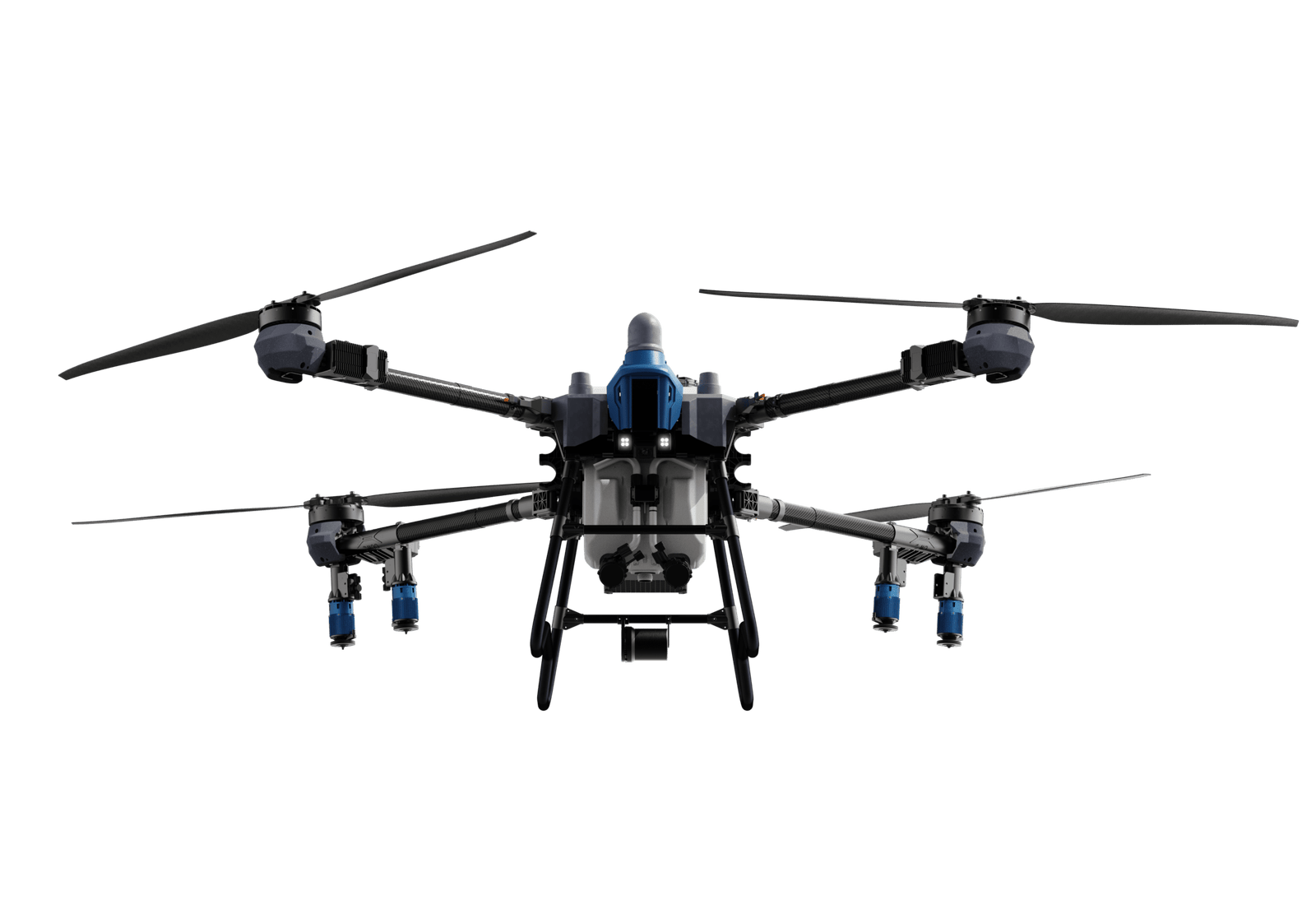
At AG Drones Inc., all our pilots hold RPAS Advanced Certification and operate under full commercial insurance. If you're purchasing an EA-J150 or EA-J70 and planning to fly your own fields, we provide RPAS Advanced Certification assistance and hands-on training through our partnership with 43 North to get you certified and in the air as quickly as possible.
For BC growers working steep Okanagan slopes, tight orchard rows, and fields that are routinely too wet or inaccessible for ground equipment, this is a significant shift. Here's what it means, what the rules actually say, and what you need to know before you put a drone in the air.
If you've been watching the regulatory landscape for agricultural drones in Canada, 2026 has been a year worth waiting for. Health Canada just issued an interim Letter of No Objection that effectively opens the door for spray drones to apply crop protection products across the country - including fungicides, herbicides, and pesticides that carry an existing aerial application label.
For BC growers working steep Okanagan slopes, tight orchard rows, and fields that are routinely too wet or inaccessible for ground equipment, this is a significant shift. Here's what it means, what the rules actually say, and what you need to know before you put a drone in the air.
What the Research Actually Shows
The regulatory green light is exciting - but it's worth pairing that enthusiasm with the practical reality of how spray drones perform in the field.
Jason Deveau, Application Technology Specialist with the Ontario Ministry of Agriculture, has been one of Canada's most active drone spraying researchers for the past five years. His work - and findings from the broader North American research community - offers some important guidance for operators:
Swath width is your most important variable. How wide a drone actually covers consistently and uniformly in your specific conditions - wind, speed, terrain, crop canopy density - is something you need to test, not assume. It varies. A drone flying over bare ground sprays differently than one flying over an established cherry canopy.
Faster isn't always better. Research using the DJI T100 found that swath width increased with speed up to about 10 m/s (36 km/h), then levelled off. Flying at 20 m/s (72 km/h) didn't increase effective coverage - it just increased the risk of drift and uneven deposition. Most experienced operators fly at conservative speeds, especially in crop.
Don't cut water volume. The policy is clear: if the aerial label specifies a minimum volume, you don't go below it. Drones don't make water go further through some magic. A droplet is a droplet. Under-applying volume is one of the fastest ways to get poor results and potentially a compliance problem.
Test in your conditions. What works on flat prairie fields in Saskatchewan isn't identical to what works on a 30-degree slope above a Okanagan vineyard. The terrain-following and obstacle avoidance on the EAVISION EA-J150 and EA-J70 are excellent, but swath width still needs to be validated in your specific set-up.
Why This Matters for Okanagan Growers Specifically
The Okanagan is exactly the kind of environment where drone spraying has the clearest advantages over conventional equipment:
Steep terrain. Many orchards and vineyards in the Okanagan sit on slopes that are genuinely dangerous or inaccessible for tractors after rain. Drones can fly 50-degree inclines with no risk of rollover.
Tight rows. The EA-J150's 4–15 m adjustable swath handles both wide field passes and tight orchard rows that would require multiple passes with ground equipment.
Wet conditions. After rain, a heavy ground rig causes compaction, rutting, and crop damage. A drone weighs nothing to the soil - you can spray the same day it rains.
Canopy penetration. The downwash from the rotors pushes droplets into the leaf canopy, giving you under-leaf coverage that even airblast sprayers struggle to achieve in dense orchards and vineyards.
No compaction, no trampling. Particularly relevant for berry crops and specialty crops where wheel traffic damage is a real economic cost.
What This Means If You're Thinking About Buying a Drone
The timing is genuinely good. If you've been waiting for the regulatory framework to stabilize before investing in an agricultural drone, that stabilization has essentially arrived.
For large-scale operations - anything over a few hundred acres, or commercial applicators serving multiple farms - the EA-J150 (73 L tank, up to 60 acres/hour) is designed for high-volume programs.
For solo operators and farms under 200 acres, the EA-J70 (45 L tank, up to 50 acres/hour) hits a practical sweet spot on cost and complexity.
Both drones include 360° LIDAR + Radar obstacle avoidance, terrain-following, and RTK GPS precision. Both qualify for the RPAS Advanced training we provide.
Before you buy, ask yourself:
How many acres do you need to cover per season? (Break-even for ownership is typically around 1,000 acres/year)
Do you have - or are you prepared to get - your RPAS Advanced Certificate?
Are your fields better suited to a custom spray service, or do the economics of ownership make sense?
We're happy to work through that math with you honestly. Sometimes a drone makes sense for a farm operation. Sometimes hiring us as a custom applicator is the smarter call. We'll give you the straight answer.
Next Steps
The regulatory window is open. Whether you're looking to hire a drone spraying service this season or invest in your own equipment, now is the time to have the conversation.
Book a demo or get a quote → support@agdronesinc.ca
Or call us directly: 888.818.7014
---
AG Drones Inc. is based in West Kelowna and serves growers across the Okanagan Valley and Interior BC - from Kamloops to Osoyoos. All pilots hold Transport Canada RPAS Advanced Certification and operate under commercial insurance.